Garage Doors
A little know-how
Every month we hear the same handful of worries from different households. This section answers them once, clearly, so you can read at your own pace and call when you are ready.
Homeowners ask
Do you look at the door between the garage and the house?
If the garage is attached, yes, briefly. That door should be tight-fitting, weatherstripped and fitted with a self-closer, because it is the barrier that keeps vehicle exhaust out of the living space. A technician who finds it propped open, missing its closer or failing to latch notes it in the report as a maintenance item, alongside the overhead door findings.
What kind of doors and openers do you service?
Residential sectional doors of every common construction: steel, insulated steel, aluminum and glass, wood and composite, single and double width, with torsion springs above the header or extension springs beside the horizontal tracks. Openers of all the usual types are covered too, including chain drive, belt drive, screw drive and wall-mounted jackshaft units. If the door is a one-piece tilt-up or a commercial rolling door, mention that when booking so the right hardware comes along.
Why did the door come off its track in the first place?
The usual causes are an impact from a vehicle, a lifting cable that broke or slipped off its drum, ice holding the door to the floor while the opener pulled, an obstruction under the door, worn rollers that no longer hold in the rail, or track brackets that have loosened from the wall. Finding which one applies is the first part of the visit, because the reset is only durable once the cause is corrected.
Is a panel the same thing as a section?
In everyday speech, yes: people call the horizontal pieces of a garage door panels. In the trade's own terminology a section is the full-width piece that hinges to its neighbours, and a panel is one of the raised or recessed shapes embossed across it, so a door might have four sections of four panels each. When you ask for panel replacement, the technician understands you mean the section, and will confirm which one.
Does a wood garage door use the same kind of seal?
Usually not. Wood doors most often carry a flat or angled strip of vinyl or rubber nailed directly to the bottom rail, rather than a profile that slides into a retainer. Replacement means removing the old strip and nails, checking the rail for soft or cupped wood, and fastening a new strip so its lip angles outward and meets the floor along the full width. A retainer can be added to a sound rail if you prefer a channel seal.
What should I do before the technician arrives?
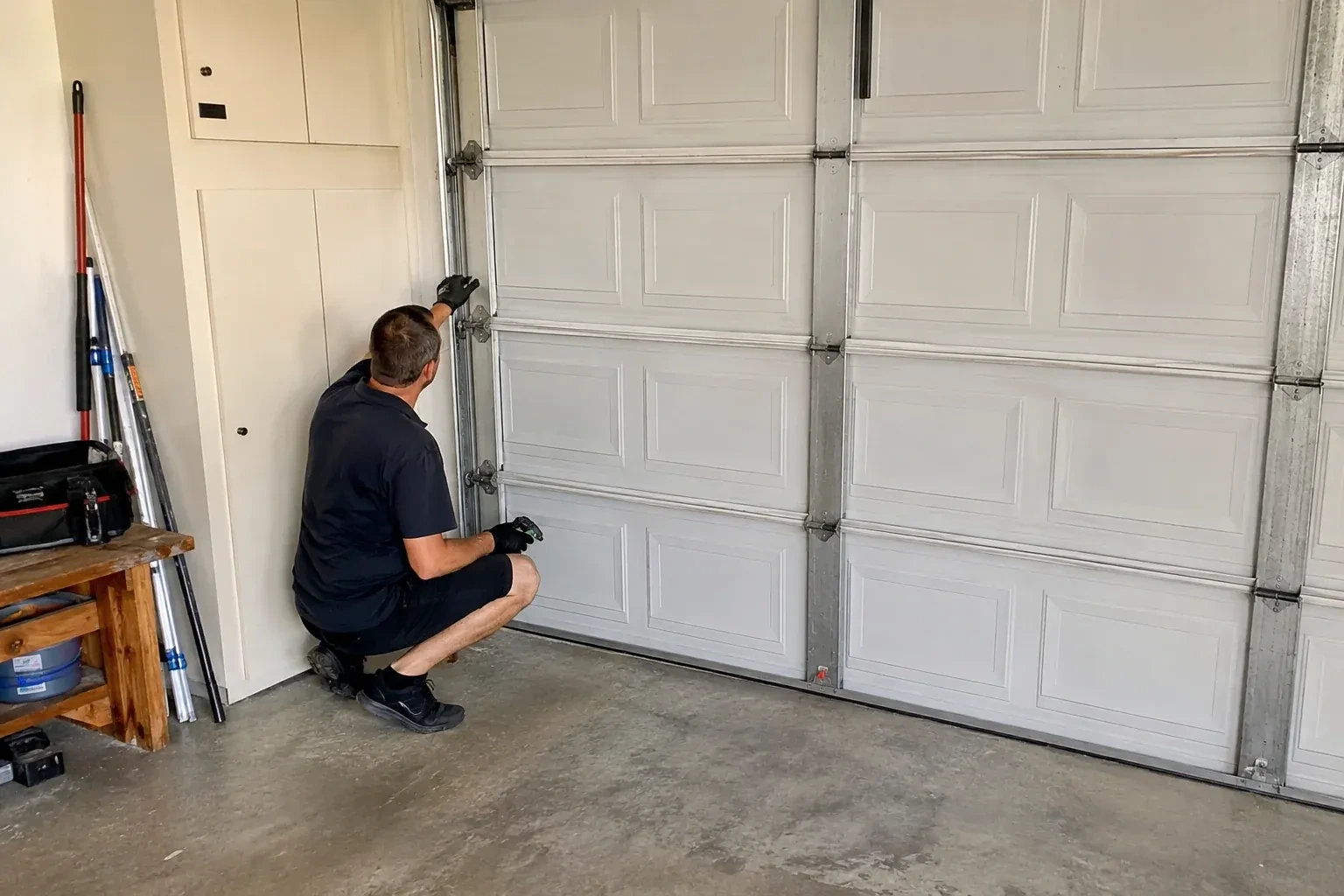
Move the car out of the garage or well back from the door, and clear anything stored against the jambs inside and any bins, planters or snow piled against them outside. Leave the door closed so the gaps can be seen as they are. If you have noticed where the daylight, drafts or snow come in, or where the mice appear, be ready to point it out.
Can I keep using the opener while the lock is jammed?
Only if you are certain the bars are fully clear of the track. If the lock is stuck in the locked position, or you are not sure, leave the opener alone and use another door until the technician arrives. A motor pulling against an engaged bar bends the bar and strains the door section and the opener, and the repair grows accordingly.
How often should the whole door be inspected?
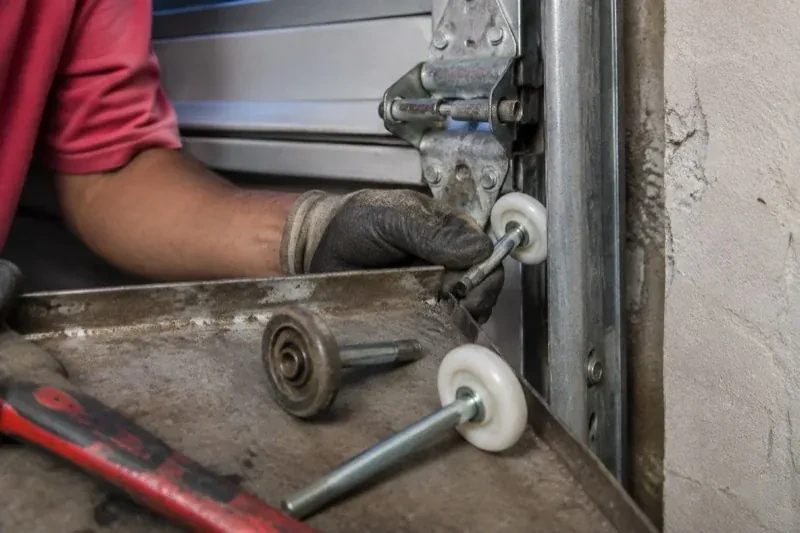
Industry guidance suggests a monthly visual and listening check by the homeowner, with the door closed and then in motion, and a yearly visit from a trained door systems technician who goes over springs, cables, rollers, hinges, track, balance and the opener's safety functions. Rollers themselves are worth a look twice a year, and they belong on the list whenever springs or cables are being replaced. A door used many times a day earns more frequent attention.
Why does the door pop or click at the same spot every time?
A noise at a fixed height points at the joint passing through the curve at that moment. A cracked hinge leaf flexing open and snapping back, a pin rocking in a worn hole, or a roller stem shifting in a loose hinge all make a sharp report as the load transfers. Because it always happens at one place, the technician can go straight to that joint and usually finds the hinge or roller responsible.
How is the vertical track attached to the wall?
Two ways are common. Bracket-mounted track uses several L-shaped jamb brackets, each lag-screwed into the wood jamb, which lets the track be adjusted a little at each bracket. Angle-mounted track bolts to a full-height continuous angle, often chosen where sideroom is tight. In both cases the fasteners bite into the jamb, so the condition of that wood matters as much as the track itself.
Does the new cable have to match the old one exactly?
It has to match the door, which may not be the same thing if the old cable was wrong. Length is set by the door height, the drum profile and the lift type; diameter and construction by the door's weight. A cable that is a little long overlaps on the drum and wears; one that is short leaves the door out of level. The technician measures the door and the drum rather than trusting the old cable.
What is the difference between torsion and extension springs?
Torsion springs mount on a shaft above the door and twist to store energy, lifting the door through cables and drums. Extension springs run alongside the horizontal tracks and stretch as the door closes, pulling it up through pulleys. Torsion systems tend to lift more evenly, take up less space beside the tracks and are the standard on most modern doors. Both are professional service items because of the energy they hold.
Do the pulleys need replacing at the same time?
Often, yes. Each side has two pulleys, one on the spring and one fixed at the front of the track, and the cable rides over both on every trip. A pulley whose wheel has worn a sharp groove, or whose bearing has stiffened, drags on the cable and adds load the spring has to overcome, which is a common reason the old spring wore early. Pulleys that spin freely and run true can stay.
How long does a balance adjustment take?
A straightforward tension adjustment on a sound door is generally about an hour, including the inspection, the hand tests and the opener checks at the end. Resetting cables to level the door, replacing rollers to remove friction, or moving to a spring replacement adds time. The technician will tell you what the inspection found and how the visit is shaping up before the work continues.
How old is too old to repair?
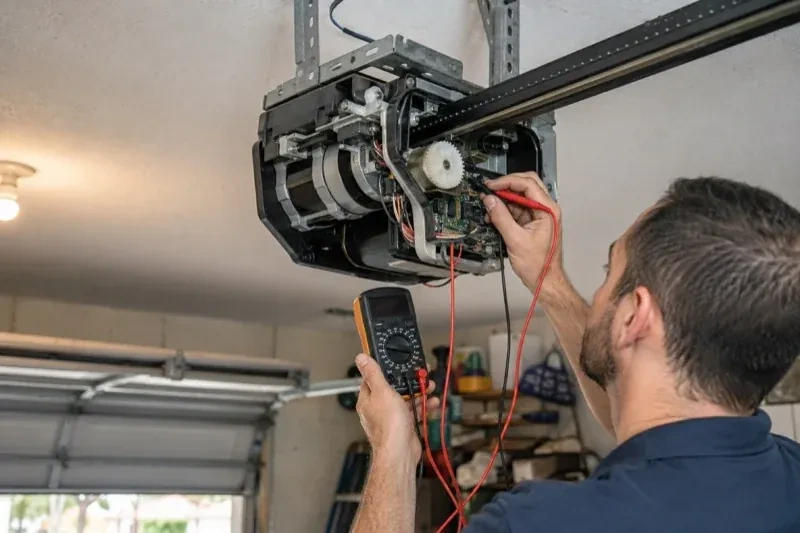
Age alone is not the test; parts and safety are. The technician checks the exact model and part numbers, because even a unit from the last two decades can have a board, sensor or trolley that is no longer made. Where the parts are available, a repair is usually straightforward. Where a key part is discontinued with nothing to replace it, or the unit predates photo eyes, replacement is the sounder choice even for a small fault. The technician tells you which side of that line your unit sits on.
Why does the technician lift the door by hand before repairing the opener?
Because the chain only guides a door that the springs already carry. With the operator unplugged and the red handle pulled, a balanced door lifts with moderate effort and holds about a metre off the floor. If it is heavy or sinks, the springs have lost tension and the drive has been hauling weight it was never meant to, which is exactly how gears strip and chains stretch. Correcting the door first means the repaired drive lasts.
Is a belt drive harder to repair than a chain drive?
No, just different. The belt is lighter, runs dry and is replaced as one length with a clip, where a chain has links and takes grease. The tensioning at the trolley works the same way on both, and the sprocket, idler and trolley are similar parts. What a belt drive rewards is care with tension and a straight rail, because it is chosen for quiet and shows any fault as noise.
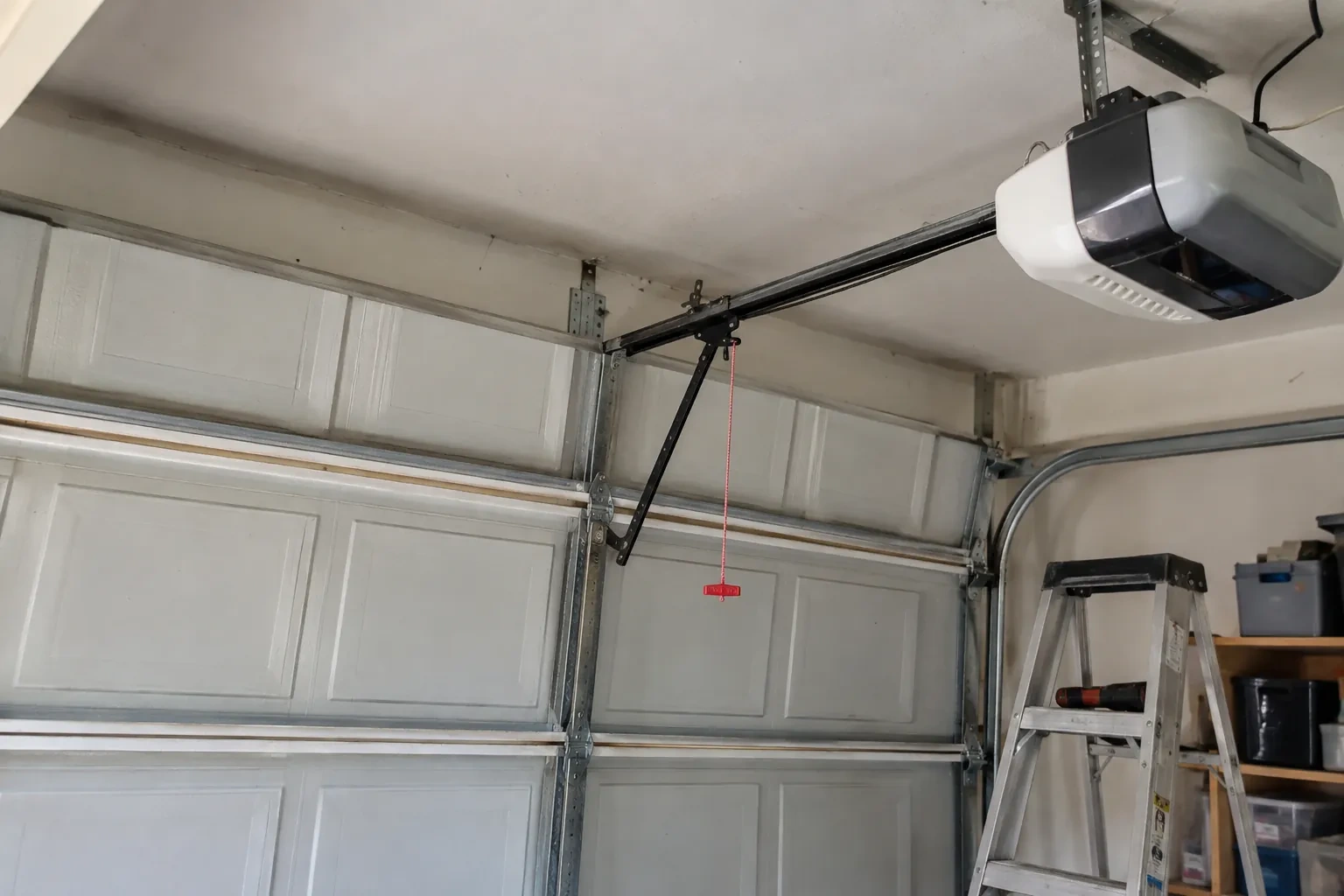
What is the red cord for?
It is the manual release. A tug on the red handle unhooks the trolley from the door arm so the door can be raised and lowered by hand while the power is off or the operator is being serviced. It hangs high enough to clear a vehicle roof but low enough to reach without a ladder. To reconnect, most units need only be run once and the trolley picks the arm back up; a few take a second tug.
Do both sensors get replaced together?
Yes. The sending and receiving sensors are made and sold as a matched pair for a given opener family, and the head unit expects both to be from the same generation. Fitting a pair also means both lenses, both indicators and both mounting points are fresh at the same time, so the alignment holds and the next check is simpler. A single sensor from an unrelated kit is where mystery faults come from.
What is rolling code and why does it matter for programming?
Most openers made from the mid-1990s on change their code every time a remote is pressed, choosing from billions of possibilities, so a copied code is usually useless next time; the technician confirms the actual system from the model, not age. Programming matters because the opener has to learn each remote's sequence at the learn button; a remote cannot simply be set to match. Older fixed-code openers, set by small switches, can be upgraded with an add-on rolling-code receiver.
Will I get an alert if the door is left open?
That is one of the first settings made. You choose how long the door can stay open before you hear about it, often ten or fifteen minutes, and the notification goes to every phone on the account or only to some. In a climate with real winters this single alert saves a good deal of heat, and occasionally a pipe in the wall shared with the house.
The outside release lock froze. How do I stop that happening again?
Salt spray and meltwater get into the keyway during a thaw and freeze overnight, the same way they do in a house lock. Keep the cylinder face clear of slush, give it a puff of dry lock lubricant before the cold sets in, and carry a small de-icer through the winter. A weather cap over the cylinder helps on a door that faces the road. The technician cleans and treats the cylinder as part of any outside release repair.
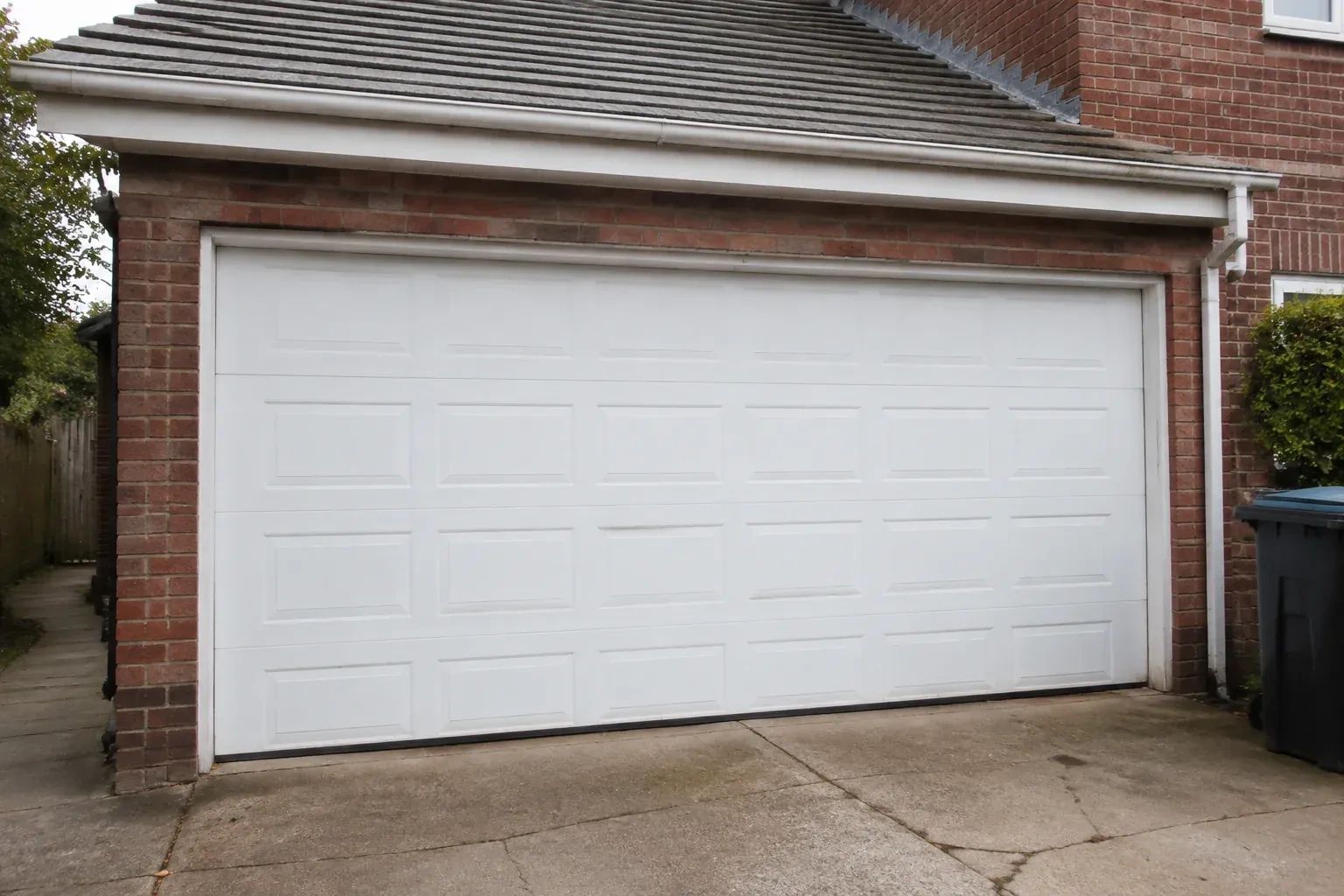
What tests are completed before handover?
The door is moved manually through its range, paused at selected positions for balance, and observed for smooth roller, cable and section travel. After a compatible opener is connected, full cycles, limits, controls, photo eyes, reversal response and emergency release are checked using the applicable instructions. Results are reviewed with the customer.
How is the opening measured before ordering?
The installer records finished width and height at multiple points, then checks the floor, jambs and header for level, plumb and useful attachment surfaces. Sideroom, headroom and backroom are measured to nearby obstructions. Beams, pipes, lights, storage racks and opener equipment are included because the door sections and tracks need a clear path from closed to fully open.
How should I care for the replacement through winter?
Keep the threshold clear of packed snow and salt, wipe residue from exposed hardware, and watch that the bottom seal releases cleanly after freeze-thaw weather. Look for corrosion, loose visible fasteners, or uneven seal contact during routine observations. Springs, cables, and bottom brackets remain high-tension components, so adjustments are left to technicians with the proper tools.
How are two side-by-side doors made to look consistent?
The layout uses shared reference lines for window height, panel divisions, handles, strap accents and exterior trim. Each opening is still measured separately because floors and jambs can differ. Samples and elevation drawings help resolve whether both doors use identical patterns or coordinated versions scaled to their widths. Installation then checks closed position and seal contact independently while preserving the planned visual alignment.
Could permits or structural review be part of the project?
A straightforward replacement in an unchanged opening differs from work that widens the opening, changes the supporting header or forms part of a larger renovation. Commercial settings may add other project requirements. The assessment identifies visible structural and site conditions, while the proposal should state who confirms permit, design and electrical responsibilities that apply to the specific property.
How is the perimeter of a new garage door sealed?
A compressible bottom seal meets the finished floor, and flexible stop moulding closes the exterior gaps at the jambs and header. Some door constructions also include seals between sections or around glazing. These materials are positioned after the sections and tracks are aligned so they contact the door without restricting movement. Floor variation, trim details and later caulking by another trade are noted during project closeout.
What causes a commercial sectional door to become noisy?
Common sources include roller-bearing wear, loose hinges, dry pivots, a rubbing panel, track movement, shaft-bearing wear and operator-chain vibration. The point in the cycle where the sound occurs helps isolate it. A technician watches and listens during controlled travel, looks for play or contact marks, and services the component creating the repeatable noise.
How can repeated vehicle damage be reduced?
Start with the impact pattern and traffic route. Guide guards, bollards, visible floor markings, mirrors, revised staging, vehicle-detection accessories or a different control position may help, depending on the site. Operators should report contact before more cycles spread a guide or curtain defect. Any protective addition must preserve required clearances and door operation.
How much ceiling height does the conversion need?
There is no single ceiling figure because the useful dimension depends on the opening height, desired clearance, track transition, shaft and spring space, opener arrangement and nearby obstructions. A technician measures the whole bay and calculates the high-lift rise that fits those boundaries. The result should be expressed as a proposed open-door clearance before the component set is ordered.